Welcome to our Festival blog

We are a small congregation commemorating the 400th anniversary of the death of the village's Elizabethan composer, William Byrd (c.1540 - 1623).

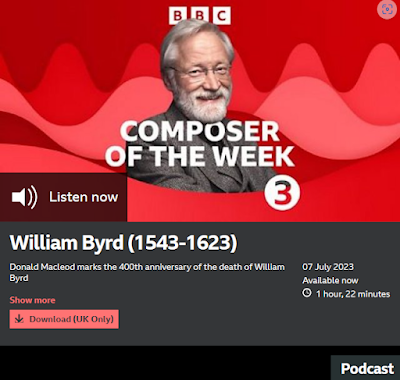
We are planning to erect a permanent memorial to Byrd to mark the quatercentenary since his death, and have begun a fundraising appeal. Our events this year have included a talk on The Life and Times of William Byrd (30 June), including book release; a Commemorative Service of BCP Evensong (2 July); and, welcomed The Stondon Singers who gave a sell-out William Byrd Anniversary Concert on the actual day (4 July). Stondon Massey has also featured on BBC Radio 3's 'Composer of the Week' programme (3-7 July).

This website contains everything you need to know about William Byrd's life and music as well as his links with Stondon Massey. /

Tuesday, 12 March 2024

Centenary of Unveiling of Tercentenary Memorial


In a new essay to commemorate William Byrd, K Dawn Grapes writes of the Tercentenary events that "The most meaningful service of the day may have taken place at Stondon Massey in Essex, where Byrd lived for some thirty years.  ... In March 1924, a tablet with Byrd's coat of arms was presented at an Evensong service."#

The following is an extract from 'The Life and Times of William Byrd: A Local History'.

The memorial, funded by a surplus from the London celebrations includes “the words, in raised lettering, “A Father of Musick”, these being taken from the Byrd entry in the ‘Cheque Book’ of the Chapel Royal”[1].

Its unveiling was marked by a Service on 12th March 1924, reported in The Times and locally in the Essex Review and the Essex County Chronicle and was attended by twenty men and boys of the Chapel Royal who sang a selection of Byrd’s work. The officiating preacher was Dr Gary Warman, the Bishop of Chelmsford, who unveiled the memorial: “Things were so arranged that the Bishop could easily manipulate the light cord from the pulpit”[2]

“Considerable local and general interest was taken in the historic event [on Wednesday] and the church was filled some time before the service started. An imposing touch of colour was provided by the long scarlet and gold-braided coats of the boy choristers, with the white laced ruffs as were used in Byrd’s time”.

“The service (which was conducted by the Rev. L. J. Percival) took the form of evensong, with sung responses by Byrd. Psalm 84, ‘O how amiable are Thy dwellings’, was chanted, and the first lesson read by Canon Reeve, was from Ecclesiastes. 44, verses 1-16. In the place of the Magnificat, Byrd’s anthem, ‘O praise the Lord, ye saints above’ was finely rendered, followed by the second lesson, read by Canon Galpin [of Faulkbourne, also president of the Essex Archaeological Society[3]], from Revelation 7, verses 9 to the end. For the Nunc Dimittus, the anthem, ‘Come to us we beseech Thee’ (Byrd), was substituted. After the third collect, ‘Justorum Animae’ (Byrd) was sung, followed at the close by the hymn ‘For all the Saints”, sung to the tune by Vaughan Williams. Practically all the singing was unaccompanied. The choir, led by Mr Stanley Roper[4], gave faultless renderings.

“The Bishop of Chelmsford, in the course of an address, said William Byrd’s gift was marked by three main features, each of interest.  He gave his best music for the rites and ceremonies of his own Church. His Church was not theirs, but they respected him. In his day, the English Liturgy was in the process of revision. Men were wanted to give musical settings for the new versions, and William Byrd gave them”[5].

“Canon Reeve [who from the outset took a keen interest in the erection of the tablet] thanked the committee for a beautiful gift in memory of the distinguished parishioner of by-gone days and said that he was honoured to accept the tablet”[6].

Reeve later wrote, “I little thought, twenty years ago, that I should have witnessed such a Service … or found Stondon so generally accepted as Byrd’s home and burial place”[7].


# The extract comes from the essay 'Reviving Byrd. The 1923 Tercentenary' contained within a new book entitled 'Byrd Studies in the twenty-first century' edited by Samantha Bassler, Katherine Butler & Katie Bank. (Clemson University Press, 2023)

[1] The Times. 17 March 1924

[2] ERO T/P 188/3 f688

[3] Canon Francis William Galpin was not only a professional colleague of Reeve but also a gifted musician and leading authority on ancient musical instruments. He wrote many articles and was co-author of ‘Church Plate in Essex’ (1926). He was a handsome man with dignified bearing, who never discarded his frockcoat and broad-brimmed hat of the Victorian age.

[4] Stanley Roper was organist and leader of the Chapel Royal choir and the director of the Elizabethan Madrigal Society. Also present was Dr. Charles Macpherson, organist of St Pauls Cathedral. The Service was conducted by the Rev. L J Percival, Preceptor of the Chapel Royal. (Source: The Times. 17 March 1924)

[5] The Times. 17 March 1924

[6] Essex Chronicle. 14 March 1924

[7] ERO T/P 188/3 f699


Monday, 31 July 2023

Byrd at the BBC: Composer of the Week Podcast

When the series is no longer available to listen to in full, this Podcast includes Byrd's life and times including at Stondon Massey: BBC Radio 3 - Composer of the Week, William Byrd (1543-1623)


Sunday, 30 July 2023

Thursday, 13 July 2023

Repeat of 'The Life and Times of William Byrd: A Local History'. Thursday 27 July 2023.


There will be another opportunity to hear 'The Life and Times of William Byrd: A Local History'. Andrew Smith will be giving a PowerPoint version of the talk at the High Country History Group.

The meeting will be held on Thursday 27 July 2023, beginning at 8pm at Toot Hill Village Hall, Toot Hill Road, Toot Hill, Ongar. CM5 9SD.

Visitors are very welcome. The entrance fee is £5.00 and will include after-talk refreshments.

For more information on the High Country History Group visit High Country History Group

The talk is available for booking. Use contact form on this site.

Wednesday, 12 July 2023

Byrd at the BBC Today

 BBC Radio 3 In Concert

Wednesday 12 July. 7.30-10.00pm

BBC Radio 3 - Radio 3 in Concert, The Sixteen at York Minster

The Sixteen Choir under their director Harry Christophers sing Byrd as part of their Choral Pilgrimage.

Music Workshop

 Read and listen to Byrd here: William Byrd 400 years on: celebrating the ‘father of music’ (music-workshop.co.uk)

Tuesday, 11 July 2023

Father Edmund Campion


An extract from the new book ‘The Life and Times of William Byrd: A Local History’ now available.  The image is from the ceiling of the English Martyrs' Chapel in Westminster Cathedral, London.

 In the early 1580s men who had been trained abroad as Jesuit priests were entering England as missionaries. One of the most high-profile was Edmund Campion, originally ordained in the Church of England. The other was Father Robert Persons (or Parsons) who we encountered earlier. These “two Jesuits strengthened the resolve of many lay Catholics to refuse conformity” through the printing and circulation of books by using “a roving press”[1]. The authorities seized many copies. Campion travels the country and is welcomed, in his own words, “to hear their confessions … [say] Mass, I preach; they hear with exceeding greediness and often receive the sacrament”[2]. But this is a dangerous course of action. From 1581, celebrating mass was punishable by death.

 A network of spies engaged by the authorities would secretly join invited congregations at recusant country houses. Campion made an ill-judged return visit to Lyford Grange in Berkshire two days following his first visit. It was there that George Eliot, a professional priest-hunter, heard Campion preach on the text ‘Jerusalem thou killest the prophets’. Jerusalem then, as in the later setting of William Blake’s poem and ‘Last Night at The Proms’ song, was reference to England: ‘England thou killest the prophets’ was an incendiary speech. Later that day the house was surrounded, and the following morning intruders discovered Campion hiding in the ‘priest’s hole’.

 John Stow’s ‘Annals of England’ was published in 1605. He records the recent events: “1581. Campion and others executed. The first of December, Edmond Campion Jesuit, Ralfe Sherwine, and Alexander Brian seminarie priests, were drawne from the Tower of London to Tiborne, and there hanged bowelled & quartered.”

 Edmund Campion, born 25th January 1540, was the same age as Byrd and as a boy had connections with St Paul’s Cathedral where Byrd’s brothers also sang. They grew up together: “A boyhood friendship between them might explain the intensity of Byrd’s musical reaction to Campion’s martyrdom”[3].

 Roy Hattersley reveals “Among the silent Catholics, who were emboldened by the execution of Edmund Campion, was the wife of William Byrd, the composer and organist in the Elizabethan Chapel Royal. She, at least according to folklore, was in the crowd that witnessed his disembowelling, and dipped her handkerchief in the martyr’s blood”. This is a souvenir or, more appropriately, a relic of the occasion.


[1] Trimble, 1964, 103

[2] Hattersley, 2017, 142

[3] Harley, 2010, 10

Monday, 10 July 2023

Byrd at Harlington


Researching William Byrd, in March 2023 I took a trip along the new Elizabeth Line to Zone 6 in West London to visit Harlington and on the way home called at Westminster Roman Catholic Cathedral to attend a service which included the great composer’s music. Harlington has not been mentioned during the Byrd celebrations on the BBC so now I make amends.

 There is little to be seen at Harlington other than the Church of St Peter & St Paul which Byrd did not attend but a school nearby is named after Byrd.


The following are extracts from the new book ‘The Life and Times of William Byrd: A Local History’ now available.


The Byrd family moved to Harlington, near Uxbridge, in 1577 where they are named by the churchwardens of the parish church for non-attendance. From 1581 fines of £20 per month were imposed for non-attendance, but it is unclear whether he actually paid any fines[1].

 “It was probably on account of his religion that he lived all his life some way out of London where he would be less likely to attract attention. His name occurs as living at Harlington in 1581, … in another entry he is described as “a friend and abettor of those beyond the seas”, and as living at Draighton”[2].


The final entry for non-attendance at Harlington is dated 7th April 1592, covering the period between 31st August 1591 and 31st March 1592. These presentations name William’s wife as Julian. At Stondon, Byrd’s wife is named Ellen, but she is the same person[3].

(During Byrd’s time at Harlington he falls under suspicion with involvement in the Throckmorton Plot then the Babington Plot to overthrow the Queen.)

In closing the net on the conspirators, Francis Walsingham, chief spymaster, and interrogator, discovered letters from Byrd to the Pagets. By February 1584 Byrd had been questioned and was expected not to stray too far from his home at Harlington.

Investigators into the Babington Plot find a letter on the person of John Reason[4], Byrd’s servant, to “m[aste]r Fyton”. Walsingham’s office diary notes: “’To seek out matters against Bryde’, ‘to sende to Fra[nci]s Mylls m[aste]r Brydes note’ and ‘To sende for M[aste]r Byrde’”[5].

 On 21st August 1586[6], Byrd’s home in Harlington is searched[7].


[1] In ‘The Elizabethans’ (2011), A.N. Wilson suggests that the Byrd family was always short of money because they were required to pay “stiff fines” for non-attendance at Church. There is no evidence to suggest that the Byrds paid any fines. Another historian suggests that the Queen personally intervened to prevent the family paying fines. Wilson also suggests that the exclusive right to print music was in some way compensation for a poorly paid job and that “the Anglo-Catholic Queen” effectively authorised the setting of Latin Masses by Byrd (Wilson, 2011, 195). Whilst there is evidence that The Queen preferred more ritual in worship authorisation of Latin Masses would be politically undesirable. Byrd though interprets the remit widely. Wilson adds elsewhere that there were many Catholic sympathisers in the legal profession, and this was acceptable “so long as they kept quiet about it and did not attempt to proselytise” (Wilson, 2011, 196). Keeping quiet about something does not necessarily mean the behaviour is acceptable. Finally, Wilson says that the government “would have deemed itself irresponsible not to suppress Jesuit missionaries” who “in most cases rightly [were] actively engaged in treason … [plotting] the murder of the head of state and overthrow of the system” (Wilson, 2011, 196). This is explored later in the text. Other historians suggest Catholic suppression was widespread – fearful of being caught.

[2] Reeve, 1900, 33

[3] John Harley (1997) says that this is an error on the part of the ecclesiastical court in Essex, assuming Byrd’s wife to be Ellen or Helena, and claims Byrd did not remarry. This is supported by Byrd’s family tree contained in Visitations of Essex dated 1634: ERO D/DQs/43

[4] Philip Brett (2007) notes that Julian Byrd and John Reason were cited for recusancy in 1577 (Brett, 2007,126)

[5] Harley, 2010, 129

[7] Caraman, 1964, 41

Sunday, 9 July 2023

Byrd at the BBC Today


Sunday Worship

Sunday 9 July. 8.10-8.45am.  BBC Radio 4

BBC Radio 4 - Sunday Worship, Psalmes, Songs and Sonnets

-

 Choral Evensong

Wednesday 5 July. 4.00-5.00pm (repeated Sunday 9 July. 3.00-4.00pm)

BBC Radio 3 - Choral Evensong, Lincoln Cathedral

Live from Lincoln Cathedral to mark the 400th anniversary of the death of William Byrd.


Sunday Feature

Sunday 9 July. 6.45-7.30pm

BBC Radio 3 - Sunday Feature, Byrd and Beyond: Challenged by Faith

Harry Christophers, conductor of The Sixteen, examines the powerful relationship between faith and music, both in Byrd’s time and the present day.

Renaissance Singers at Ingatestone Hall: Saturday 21 October 2023

 Book quickly if you want to attend one of these Concerts to be held at Ingatestone Hall: The Renaissance Singers - specialist London chamber choir


'Sunday Worship' on BBC Radio 4 recorded at Stondon Massey Church

William Byrd is regarded as one of England's greatest composers. He lived through turbulent times through the Sixteenth and early-Seventeenth Centuries, witnessing both significant religious and political change. Despite this, he composed some of the finest music of his time for both the Catholic and Anglican Church.

  In the week of the 400th anniversary of his death, The Revd Dr Jonathan Arnold reflects on William Byrd's contribution to Christian music and worship. Jonathan visits the Church of St Peter and St Paul, Stondon Massey in rural Essex - where Byrd is thought to be buried - and also the nearby Ingatestone Hall, the home of the composer's patron, Lord Petre. Jonathan speaks to the current Lord Petre about the connection between Byrd and his patron through their Catholic faith.
  
Harry Christophers, founder and director of The Sixteen, reflects on the sense of longing and faith in Byrd's music, expressed in the composer's particular attention to the texts he set from scripture, and there are contributions from Byrd scholar Professor Kerry McCarthy, music historian Dr Katie Bank, and singer and conductor Dr David Allinson.
  
Byrd remained a Catholic throughout his life, which for many at the time was a dangerous thing to do, but his contribution to music for the Anglican church remains central to music and worship in many churches today.
  
The readings are Isaiah 64 vv.9-10 - read by our Vicar, Revd. Sam Brazier-Gibbs - (the Latin text of which Byrd set in his motet Ne irascaris, Domine), and Colossians 3 vv.12-17, in which St Paul encourages his readers to 'sing psalms, hymns, and spiritual songs to God'.
  
Byrd's music featured includes Ne irascaris Domine, Tribue Domine, the Nunc dimittis from the Second Service, and movements from his three Masses.
 

The programme was first broadcast on BBC Radio 4, Sunday 9 July 2023, 8.10-8.48am. Available on BBC Sounds for 30 days: BBC Radio 4 - Sunday Worship, Psalmes, Songs and Sonnets

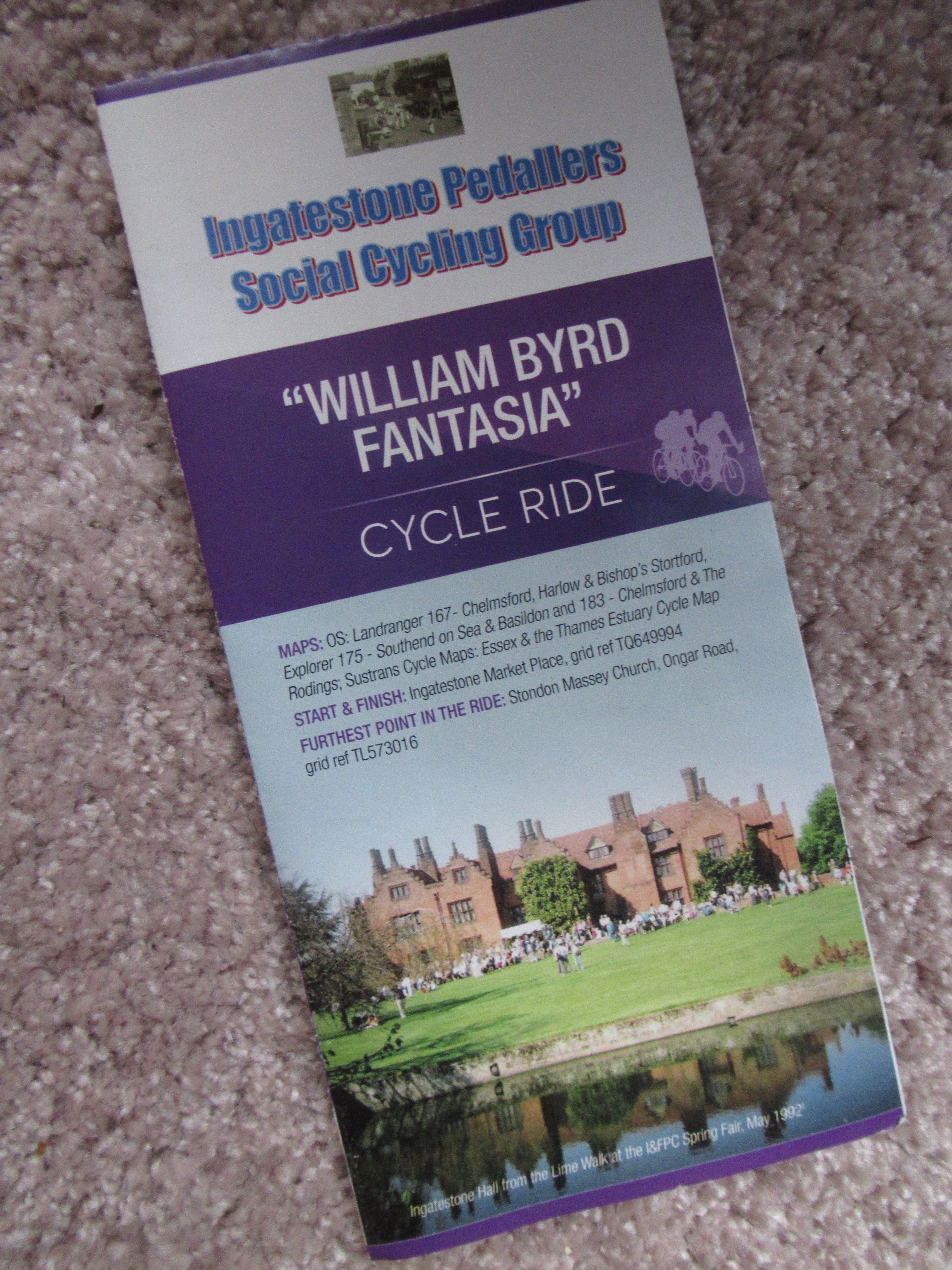
Byrd Bike Ride


Members of Ingatestone Pedallers social cycling group called in at Stondon Massey Church last Sunday (2 July) in celebration of William Byrd. 

The 'William Byrd Fantasia' cycle ride was created a few years ago by local historian Robert Fletcher visiting two places strongly associated with the great composer: Ingatestone Hall, the home of the Petre family, and the churchyard at Stondon Massey, where Byrd is believed to have been buried in 1623. 

The 16-mile route passes Stondon Place, Byrd's home, and calls in at Byrd Mead near the Bricklayers Arms which are council homes for elderly residents built in 1985.

The group was shown around the church and viewed Byrd's Will and engraving which hang in the Vestry.


Friday, 7 July 2023

Byrd at the BBC Today


Composer of the Week

BBC Radio 3

Friday 7 July. 12.00-1.00pm.

BBC Radio 3 - Composer of the Week, William Byrd (1543-1623), Stondon Massey

BBC Music Magazine, July 2023, regards this programme as ‘Choice’ listening.


Unclassified

Thursday 6 July. 11.30pm-12.30am

BBC Radio 3 - Unclassified, Byrd Reworked

Elizabeth Alker shares original unclassifiable sonic creations made especially for the programme, as three contemporary composers offer new takes on the music of William Byrd to mark four hundred years since the Renaissance man’s death.


The Listening Service

Sunday 2 July. 5.00-5.30pm (repeated Friday 7 July 4.30-5.00pm)

BBC Radio 3 - The Listening Service, Secret Music: Byrd's Masses

Tom Service explores the three mass settings of William Byrd during dangerous times for Catholics.

Thursday, 6 July 2023

Byrd at the BBC Today

 Composer of the Week

BBC Radio 3

Thursday 6 July. 12.00-1.00pm.

BBC Radio 3 - Composer of the Week, William Byrd (1543-1623), Recusant

BBC Music Magazine, July 2023, regards this programme as ‘Choice’ listening.

Wednesday, 5 July 2023

Byrd at the BBC Today

 Composer of the Week

BBC Radio 3

Wednesday 5 July. 11.40-12.40pm.

BBC Radio 3 - Composer of the Week, William Byrd (1543-1623), The Chapel Royal

BBC Music Magazine, July 2023, regards this programme as ‘Choice’ listening.


Choral Evensong

Wednesday 5 July. 4.00-5.00pm (repeated Sunday 9 July. 3.00-4.00pm)

BBC Radio 3 - Choral Evensong, Lincoln Cathedral

Live from Lincoln Cathedral to mark the 400th anniversary of the death of William Byrd.


Crowds Flock to William Byrd 400th Anniversary Concert

 The Stondon Singers held a special concert at St Peter and St Paul Church, Stondon Massey last night (Tuesday 4 July) to mark the 400th anniversary of the death of William Byrd (c1540-1623) in the parish where he lived. The calendar seemed coincidentally arranged because the singers, formed in 1968 to sing the great composer's work, always have the first Tuesday in July for the Anniversary Concert.

Hilary Punnett is now their conductor having now led for a season, and this was her first at Stondon Massey.

The programme, entitled 'Patronage and Persecution' considered the theme of royal patronage throughout the ages as well as pieces which reflected the persecution Byrd faced as a recusant Catholic.

The pieces performed were:

Byrd: Vigilate

Thomas Tallis (1505-1585): Miserere nostri

Judith Weir (b. 1954): Love bade me welcome

Andrew Balfour (b. 1967): Ambe

Byrd: In winter cold (prima pars), and Whereat an ant (secunda pars)

Byrd: Tristitia et anxietas

Orlando Gibbons (1583-1625): O clap your hands together

interval

Byrd: Sing Joyfully

J.F. Woolley: Rest

Byrd: Miserere mei

Andrew Balfour: Vision Chant

Robert Carver (1485-1570): Missa dum sacrum mysterium - Sanctus

Robert Parsons (1535-1572): Ave Maria

Byrd: Haec dies

Sunday Worship on BBC Radio 4 comes to Stondon Massey


Sunday Worship

BBC Radio 4

Sunday 9 July 2023

Psalmes, Songs and Sonnets

BBC Radio 4 - Sunday Worship, Psalmes, Songs and Sonnets

William Byrd is regarded as one of England's greatest composers. He lived through turbulent times through the Sixteenth and early-Seventeenth Centuries, witnessing both significant religious and political change. Despite this, he composed some of the finest music of his time for both the Catholic and Anglican Church.

In the week of the 400th anniversary of his death, The Revd Dr Jonathan Arnold reflects on William Byrd's contribution to Christian music and worship. Jonathan visits the Church of St Peter and St Paul, Stondon Massey in rural Essex - where Byrd is thought to be buried - and also the nearby Ingatestone Hall, the home of the composer's patron, Lord Petre. Jonathan speaks to the current Lord Petre about the connection between Byrd and his patron through their Catholic faith.

Harry Christophers, founder and director of The Sixteen, reflects on the sense of longing and faith in Byrd's music, expressed in the composer's particular attention to the texts he set from scripture.

Byrd remained a Catholic throughout his life, which for many at the time was a dangerous thing to do, but his contribution to music for the Anglican church remains central to music and worship in many churches today.

Byrd's music featured includes Ne irascaris Domine, Tribue Domine, the Nunc dimittis from the Second Service, and movements from his three Masses.

Tuesday, 4 July 2023

Stondon Singers: William Byrd 400th Anniversary Concert


Happy Byrd Day to you!

We welcome the Stondon Singers for their annual Concert remembering William Byrd who died this day in 1623.

The sell out Concert is about to begin!